
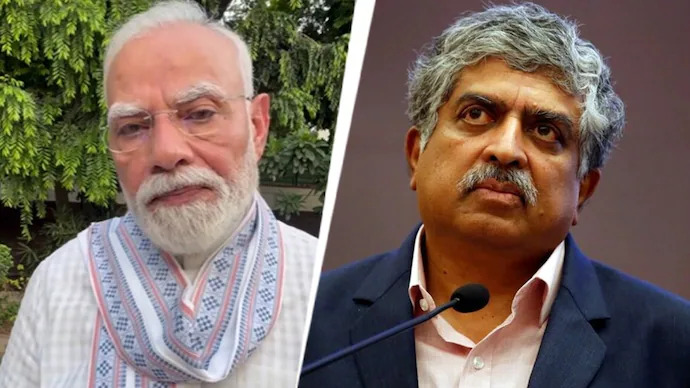
Government turns to technology-driven reform after paper-leak protests and education minister’s resignation
NEW DELHI, July 26, 2026 — Prime Minister Narendra Modi has announced the formation of a high-powered task force led by Infosys co-founder Nandan Nilekani to recommend structural and technological reforms to India’s examination system.
The announcement followed weeks of demonstrations over examination-paper leaks and came one day after Education Minister Dharmendra Pradhan resigned under pressure from a nationwide youth movement.
In an official statement, the Prime Minister’s Office confirmed that the task force had been constituted under Nilekani’s leadership. Modi said the government wanted to make public examinations more trustworthy, transparent and secure through greater use of technology.
Nilekani is best known as an Infosys co-founder and a principal architect of Aadhaar, India’s nationwide digital identity programme. His experience in designing large-scale digital infrastructure is expected to inform the task force’s examination-security recommendations.
Technology expected to play central role
The task force is expected to study vulnerabilities across the examination process, including the preparation and distribution of question papers, candidate verification, security at testing centres and the handling of results.
The government has not yet published the task force’s complete terms of reference, reporting deadline or final implementation schedule. Its recommendations will therefore require further policy decisions before they become binding changes.
Modi said the government would act on the panel’s report to improve the credibility of future examinations. He also indicated that legislation containing tougher provisions against paper leaks and examination fraud would be introduced in Parliament.
The proposed legislation should not be treated as law until Parliament passes it and the required constitutional process is completed. Detailed penalties reported by individual media outlets should similarly be regarded as proposals unless included in an officially published bill.
Protests forced political response
The decision follows sustained demonstrations organized by the youth-led Cockroach Janta Party, or CJP. The movement demanded Pradhan’s resignation, reforms to the examination system and the withdrawal of police cases filed against protesters.
The government also accepted a demand concerning compensation for families of students reported to have died by suicide following the examination controversy. The relationship between each reported death and the paper leaks has not been independently or judicially established in every case.
The CJP ended its street demonstrations after the government accepted its principal demands. Protesters celebrated Pradhan’s resignation as an important victory, but public attention is now expected to shift toward whether promised reforms are implemented.
Restoring public confidence
India’s competitive examinations determine access to universities, professional programmes and government employment for millions of candidates. Paper leaks can therefore disrupt academic plans, impose financial burdens on families and undermine confidence in public institutions.
The task force will be judged on whether it can recommend security measures that protect confidential examination material without creating new privacy, accessibility or digital-exclusion concerns.
Why it matters
The panel’s recommendations could reshape examinations taken by millions of Indian students. Its success will depend on transparent procedures, enforceable safeguards and timely implementation—not solely the introduction of new technology.