
Bhutan Turns to Gelephu Mindfulness City as Youth Migration Tests Its Development Model
The Himalayan kingdom hopes a new special administrative region can create skilled employment without sacrificing its cultural identity or environmental commitments
THIMPHU/GELEPHU, July 2026 — Bhutan’s development philosophy has long attracted international attention for placing public wellbeing alongside economic growth. But the small Himalayan kingdom is now confronting a difficult reality: many of its youngest and most highly educated citizens are leaving in search of better salaries, education and career opportunities abroad.
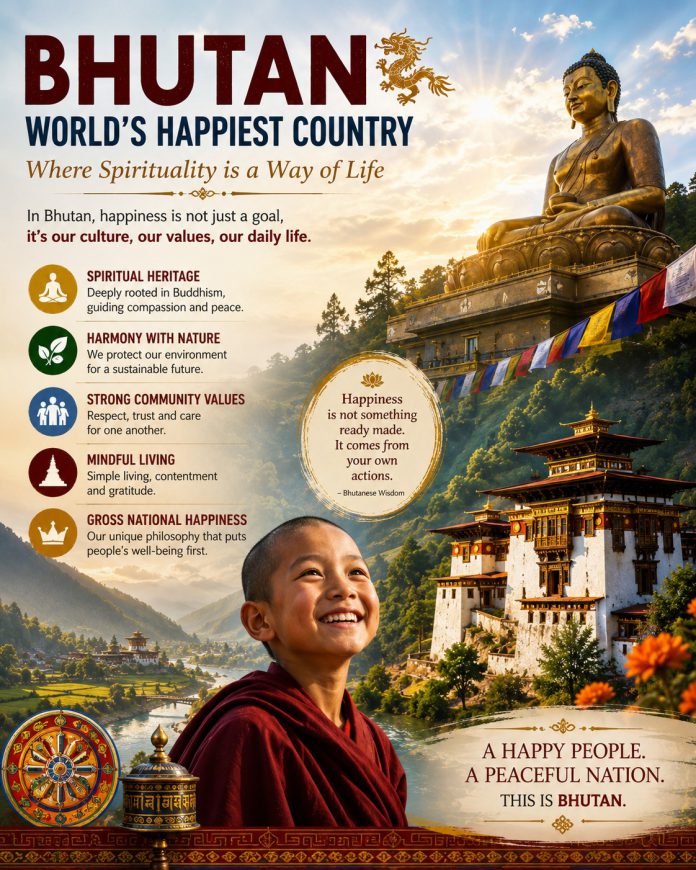
Bhutan is often described informally as the world’s “happiest country” because it promotes Gross National Happiness as a national policy framework. However, that description should not be confused with the annual World Happiness Report, which ranked Finland first in 2026. Bhutan’s global reputation comes principally from its distinctive approach to governance, cultural preservation and environmental protection.
Skilled-worker migration creates pressure
A World Bank assessment found that approximately 9% of Bhutan’s population had emigrated by 2025. Youth unemployment remained significantly higher than the national average, reaching approximately 20.6%.
The country’s population is below 800,000, meaning the departure of even a relatively small number of skilled professionals can produce serious shortages.
World Bank research shows that 53% of recent Bhutanese migrants held university degrees, compared with approximately 7% of the country’s working-age population. Civil servants accounted for nearly half of those leaving, and education and healthcare employees represented almost 70% of voluntary civil-service resignations during 2024.
Australia has emerged as the leading destination. Between January and September 2024, approximately 13,406 Bhutanese students were enrolled at Australian educational institutions.
Higher earnings are an important motivation. The World Bank found that many migrants who earned below 40,000 ngultrums per month in Bhutan could make at least 60,000 ngultrums after moving to Australia. Education, career progression and established diaspora networks also influence migration decisions.
Gelephu presented as an economic alternative
Bhutan is placing considerable hope in Gelephu Mindfulness City, commonly known as GMC. The project is intended to create domestic employment, attract international investment and provide young Bhutanese professionals with opportunities comparable to those available overseas.
Established by Royal Charter in December 2024, GMC is a highly autonomous Special Administrative Region covering more than 2,600 square kilometres along Bhutan’s southern border with the Indian state of Assam. That area represents approximately 5% of Bhutan’s territory.
The region has been granted its own executive and legislative authority and an independent judiciary. Its governing framework is separate from Bhutan’s regular administrative system, although it remains part of the kingdom.
GMC’s official development strategy focuses on combining economic activity with Bhutanese spiritual traditions, environmental protection and responsible urban planning. Proposed priority sectors include healthcare, wellness, education, technology, financial services, green energy and other knowledge-based industries.
Rather than building a conventional industrial centre, Bhutan wants Gelephu to demonstrate what it calls “mindful prosperity”—economic development designed around human wellbeing, cultural identity and ecological sustainability.
Strategic location near India
Gelephu’s location could be central to the project’s success. Situated next to Assam, the region is intended to connect Bhutan more closely with Indian transportation, investment and commercial networks while eventually serving as an economic corridor between South and Southeast Asia.
India’s cooperation will be important for road and rail connectivity, aviation access, energy infrastructure and regional trade. The development could also create opportunities for Indian businesses, universities, healthcare providers and technology companies.
The project remains a long-term undertaking, and important questions remain about financing, infrastructure, environmental impact, international investment and the ability to attract—and retain—the skilled workforce required to build the city.
Can economic opportunity bring Bhutanese youth home?
Research suggests many Bhutanese migrants remain emotionally connected to their country and could consider returning if suitable employment and income opportunities become available. However, salary expectations among some potential returnees are substantially higher than what Bhutan’s present labour market can support.
Gelephu Mindfulness City is therefore more than an urban-development project. It represents an attempt to address Bhutan’s youth migration, limited private-sector employment and dependence on a narrow economic base.
Whether GMC can deliver jobs on the scale required remains uncertain. But Bhutan’s strategy is clear: create a modern economic centre that gives its young people a reason to stay—or return—without abandoning the spiritual, cultural and environmental principles that distinguish the country.